About me
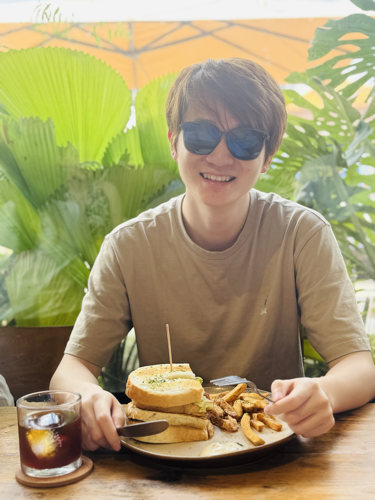
My name is Shuwei Li (李书伟). I will soon be joining Mike Shou’s Show Lab at the National University of Singapore as a research fellow. I received my Ph.D. from NUS, where I was advised by Prof. Robby T. Tan. Prior to that, I received my bachelor’s degree from Southeast University and my master’s degree from Boston University.
My doctoral research focused on color constancy via deep learning. I find color fascinating because it lies at the boundary between the world as it is and the world as we perceive it.
Outside of research, I find my peace and freedom in driving alone at nightfall.
Publications
[ECCV 2026] UC-VLM: Consistency-Driven Learning for AI-Generated Image Detection with Vision-Language Large Models
The first VLM training framework for AI-generated image detection without reasoning annotations, achieving 96.7% / 82.4% accuracy on GenImage / Chameleon.
[ICML 2026] FUSE: Frequency-domain Unification and Spectral Energy Alignment for Multi-modal Object Re-Identification
A multi-modal object re-identification framework that aligns cross-modal representations via frequency-domain unification and spectral energy alignment.
[CVPR 2026] White-Balance First, Adjust Later: Cross-Camera Color Constancy via Vision-Language Evaluation
Reformulates color constancy as an iterative perceptual-feedback process using VLMs, achieving 36.8% reduction in mean angular error and 43.6% in Worst-25% error on the Gehler-Shi dataset.
[AAAI 2026] Aggregating Diverse Cue Experts for AI-Generated Image Detection
Proposes a Mixture-of-Encoder Adapter (MoEA) framework that integrates diverse cues for robust AI-generated image detection, achieving 89.7% average accuracy on GenImage.
[AAAI 2026 (Oral)] Bridging Day and Night: Target-Class Hallucination Suppression in Unpaired Image Translation
The first I2I translation framework that actively detects and suppresses target-class hallucinations using a dual-head discriminator with SAM2 pseudo-labels, improving mAP by +15.5% on BDD100K day-to-night adaptation. Oral presentation.
[CVPR 2024] NightCC: Nighttime Color Constancy via Adaptive Channel Masking
An unsupervised domain-adaptation pipeline for nighttime color constancy using Adaptive Channel Masking and a Light Uncertainty module, reducing mean angular error by 21.5% over prior state-of-the-art.
[Arxiv 2022] MIMT: Multi-Illuminant Color Constancy via Multi-Task Local Surface and Light Color Learning
A multi-task learning framework for color constancy under multiple illuminants via joint local surface and light color estimation.
Photography
When I’m not working, I shoot photos sometimes.